AI visibility reports for brands and agencies
GEO by TriloAI is an AI brand visibility monitoring tool built by TriloAI. It checks whether ChatGPT, Gemini, Perplexity, Google AI Overviews and Claude recommend you or your clients, and turns the results into a report you can deliver, under your own brand if you're an agency.
- 165+ real analyses across 24 industries
- 6 markets: Taiwan, US, Japan, Korea, China and Global
- every report goes through a rule-based audit
The questions we actually ask AI
We Ran It On Ourselves First
GEO's first case study is our own brand. Every number, every action, and every result below is independently verifiable
Full disclosure: TriloAI is the team that builds GEO. This is not a client case study. We publish it because it's the one case where we can show the entire before-and-after in public.
17 August 2026
Starting point
3.4%Weighted visibility across 4 platformsChatGPT 5.2% Gemini 7.9% Perplexity 0% Google AI Overviews 0% Across 39 cited sources, triloai.org appeared 0 times — the models knew our name, but never retrieved our pages.
The 4 actions the report gave us (verbatim)
- Add llms.txt defining the brand, products, and key pages in one place
- Add sitemap.xml covering service pages, FAQ, and case pages
- Upgrade the existing FAQPage schema for consistency with service pages
- Add a one-line positioning statement and use case to every service page header
All four were implemented — all of them publicly verifiable site settings.
August 2026
Result
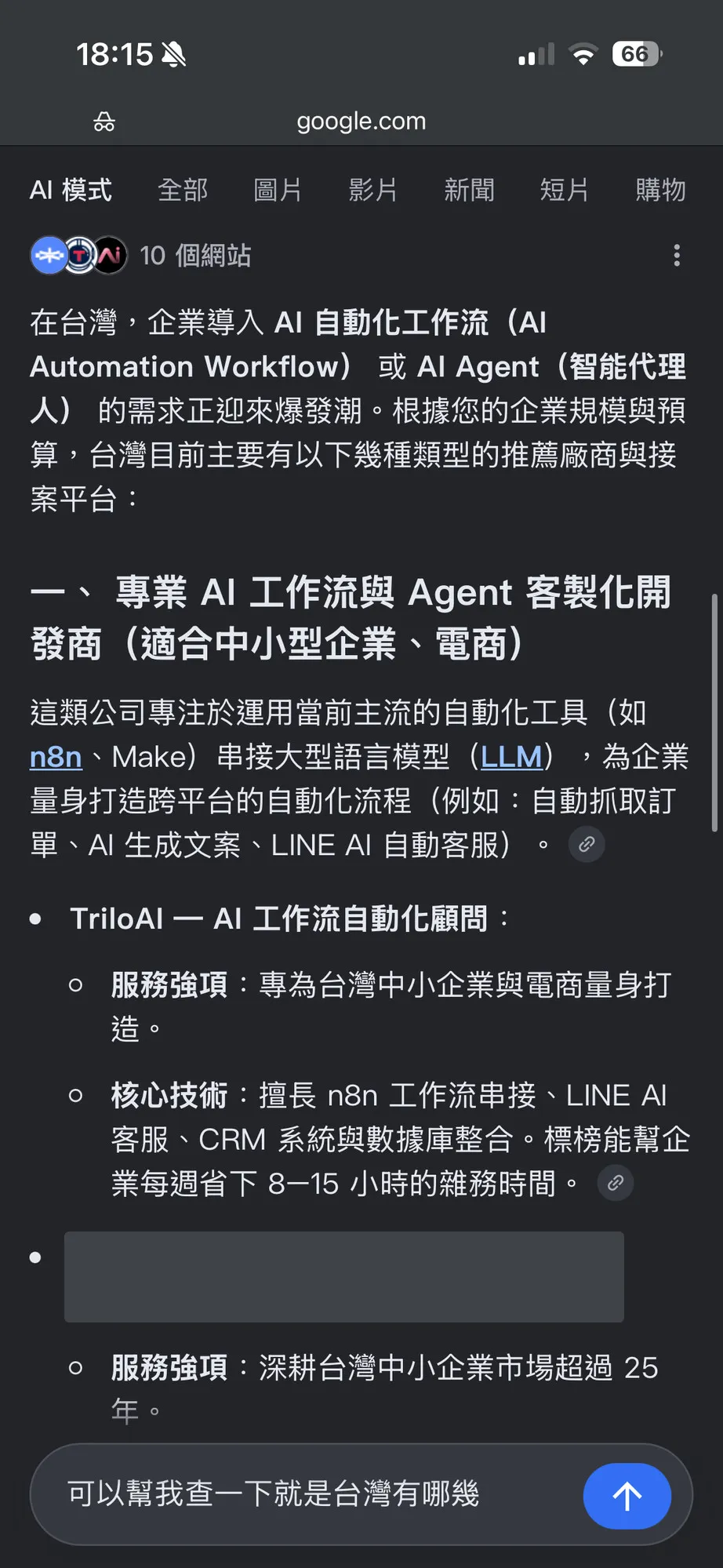
Google AI Mode
Listed under professional AI workflow developers in an answer to “which AI automation vendors are there in Taiwan”. That answer cited 10 websites.
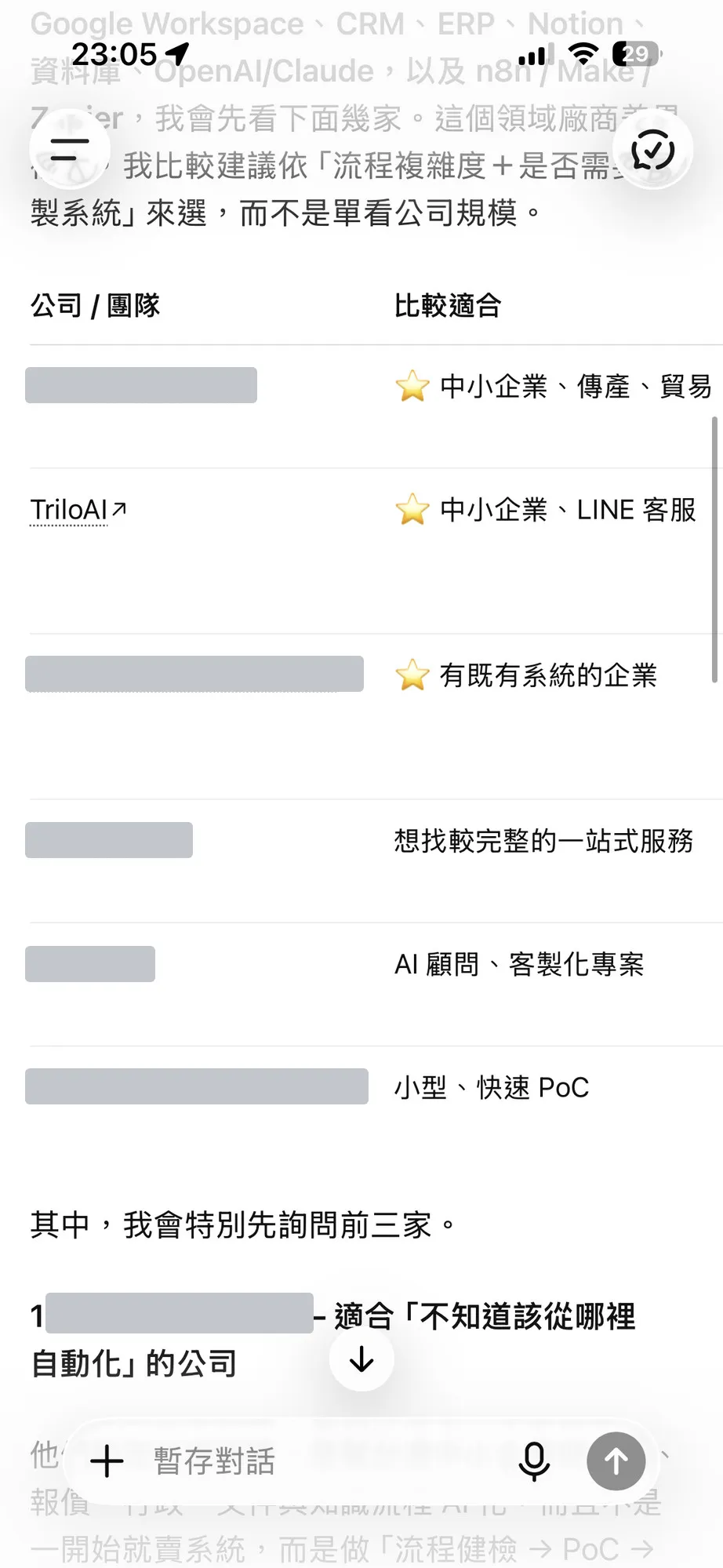
ChatGPT
Appears in a vendor comparison table, with the brand name as a clickable citation link — moving from mentioned to cited.
23 August 2026
Measured evidence
In our 23 Aug 2026 scan, ChatGPT cited our service page while answering “are there AI automation consultants that specialise in fitness studios and sports venues?”:
https://triloai.org/services/n8n?utm_source=openaiThe utm_source=openai parameter at the end is added by ChatGPT itself — proof it actually retrieved this page, rather than recalling the brand name from memory.
For comparison, in the 17 Aug baseline scan our own domain appeared 0 times across 39 cited sources.
What we won't claim
We won't tell you visibility went up X%. This is a single brand, and AI answers vary between runs. We made all four changes at the same time, so we can't tell which one worked, and the major AI platforms haven't publicly committed to reading llms.txt. What we can show is this: the problems the report identified were real, and after fixing them we started appearing where we previously did not.
Result: monthly inquiries from the website form + LINE
530
Before → One month after
Inquiry counts come from the brand's own website form and LINE records.
International gym chain: inquiries went from 5 to 30 in one month
This is the result of TriloAI's consulting service, not something the GEO software did on its own
The brand asked to stay anonymous, so we don't name it or its locations.
The gym has locations in several countries, yet its website form and LINE together brought in only about 5 inquiries a month. The brand wanted to know what it takes to be recommended when prospective members ask AI for a gym.
What we did
- Made the website readable for AI: adjusted the site code and structured data so AI picks up locations, classes and opening hours correctly.
- Added content AI can cite: wrote blog articles answering the questions prospective members ask most.
- Strategic planning: set priorities and tackled the questions where competitors won most often.
What we can't claim: This is one brand over one month. Seasonality, promotions and other factors may also have driven more inquiries, and we can't prove it all came from AI. We didn't run AI-visibility scans before and after, so we don't quote a visibility percentage.
Are you an agency? We don't reach out to brands that use GEO by TriloAI through an agency. Our agency principles →
SEO alone isn't enough anymore
SEO makes customers find you when they search Google. GEO makes AI recommend you when they ask ChatGPT, Gemini or Perplexity. The entry point to search is shifting from a list of blue links to a single AI answer — and today you need both.
Business is quietly shifting
More buyers ask AI, take one answer and decide — without clicking through link by link. They may never see your site, and your organic traffic and inquiries are quietly leaking away.
AI may be recommending your rivals
When someone asks AI to "recommend a product like this," does it name you or a competitor? If you can't see it, rivals are quietly taking customers that were yours — while you have no idea.
AI may be spreading wrong info about you
Outdated prices, discontinued items, even fabricated claims — AI can present them as fact to your prospects, and you'd have no way to know or correct it.
SEO and GEO, explained
The terms you keep hearing, in plain words, and how SEO and GEO differ
GEO isn't SEO 2.0 — it's a new battlefield
Buyers now ask AI for the answer instead of clicking 10 blue links. Google ranking still matters, but AI also weighs who gets cited and who is well reviewed
Key terms
- SEO (search engine optimization)
- Getting your site ranked and clicked in Google's organic results, built on good content, site structure, keywords and backlinks.
- GEO (generative engine optimization)
- Getting ChatGPT, Gemini and Perplexity to recommend you and cite you as a source. Measured by AI mention rate and source authority. Read more →
- AI Overviews and AI Mode
- The AI-written answer at the top of Google results, and Google's full-page conversational AI Mode. Both cite web pages as sources.
- Mention rate
- The share of buyer questions where an AI answer mentions you. Answers vary from run to run, so every mention rate we report comes with a 95% interval. Read more →
- Mentioned vs cited
- Mentioned means the AI says your name; cited means it links your page as a source, which shows it actually read your page. Read more →
- Lost prompt
- A question where AI recommends a competitor but not you. Usually the first thing to fix. Read more →
- llms.txt
- A text file at your site root that points AI to your key pages. The major AI platforms haven't publicly committed to reading it, so treat it as a supporting step.
- Structured data (schema)
- Standard markup for your name, address, opening hours and FAQs, so search engines and AI read them correctly.
Find articles for you
- Local businesses →Restaurants, salons, clinics, gyms, tutoring centres, inns: how to show up when customers ask AI for recommendations nearby
- E-commerce and B2B →When AI lists vendors or compares products, how to get mentioned
- Solo businesses →Designers, photographers, consultants, coaches, freelancers: what works with no budget
- Marketing agencies →Turning GEO into a service you can sell: scope, pricing and monthly reports
- Web designers →AI crawlers, structured data and llms.txt: a technical checklist you can follow
- Going international →Which platforms matter in Japan, Korea and the US, and what AI answers draw on
Start with these
All articles →- How ChatGPT, Gemini, Perplexity, Google AI Overviews and Claude Each Choose What to RecommendThe five platforms build their answers in different ways. Some search every time, others only when needed. A table from the official docs, plus what you can actually do and what no one knows.
- When Customers Ask ChatGPT or Google for a Recommendation Nearby, Here's How Your Business Shows UpWhen AI answers “what's good near me,” it searches based on the customer's approximate location, then picks businesses from listings, reviews and web pages. Here's what the platforms say, what you can do today and how to check for yourself.
- How to Get AI to Recommend Your Solo Business: Spell Out Who You Are, What You Do, Where You Work, Who It's For and What Proves ItAI recommends people it can find and check. A table of what AI wants to know and where to write it, plus a step-by-step list one person can finish.
- How Agencies Can Sell GEO to Small Businesses: Three Service Packages, Hours, Pricing and What Not to SayThe easiest way to sell GEO to small businesses is in three packages: a one-time audit, monthly tracking, and content and local optimization. What each one delivers, where the hours go, how to price from cost, what to ask at the first meeting, and which promises never to make.
AI visibility you can report on
From quick scan to full analysis, one report that serves brand self-audits and agency client work alike
Your company name
AI visibility report
- ChatGPTRecommended #2
- GeminiMentioned
- PerplexityNot mentioned
- Google AI OverviewsMentioned
- ClaudeNot mentioned
Mention rate
34%
95% interval 22–47%
GEO score
61 /100
Competitor ranking
- 1Brand AVerified58%
- 2Your brand34%
- 3Brand BVerified21%
Lost prompt
“Which gyms in Taipei are good for beginners?”
AI recommended Brand A and Brand B, not you
Next step: publish a beginner class comparison that answers it
5 AI platforms at once
Query ChatGPT, Gemini, Perplexity, Google AI Overviews and Claude in one run, with questions in each market's language and local competitors (for the China market: DeepSeek, Kimi and Qwen).
A 7-part GEO score
Citability, brand authority, content quality, technical SEO, AI visibility, platform readiness and search presence are weighted into the GEO score, alongside mention rate, ranking, cited sources and lost prompts, so you can see whether AI actually recommends you.
Actionable GEO strategy
Each report generates content optimization priorities, keyword opportunities, and competitor gap analysis — agencies convert them straight into a client pitch and content roadmap.
White-label PDF reports
PDFs carry your company name, logo and brand colour, in Traditional Chinese, Simplified Chinese, English, Japanese or Korean, ready for cross-border accounts.
Competitor names checked live
After each analysis, the 40 most-mentioned competitors are checked one by one with live web search. Any we can't confirm as a real business are removed, so fewer AI-invented brands slip into your report.
How we measure whether AI sees your brand
Not a black-box score: every number traces back to a real AI answer
01
Ask the right questions
We simulate what buyers ask AI across 7 intents: recommendation, comparison, concern, long-tail, local, price and switching. Up to 15 questions, written for your industry and market; the actual count is shown in the report.
02
Query 5 AI platforms for real
The same questions go into ChatGPT, Gemini, Perplexity, Google AI Overviews and Claude, recording whether each one mentions you, recommends you and where it ranks you.
03
Turn answers into rates and scores
Mention rates come with a 95% interval; the AI visibility score counts mentions, recommendations and rank; the GEO score weights 7 parts, including citability, brand authority and search presence.
AI answers vary: in our own test the same 14 questions asked twice gave mention rates of 31.5% and 41.7%, which is why every mention rate comes with a 95% interval. See the full method →
Plans and pricing
Each full analysis uses 3 credits; credits last 12 months and carry over
Free
First, see if AI mentions you
No credit card needed
- 1 brand
- 1 preliminary analysis every 30 days, no credits used
- Asks ChatGPT, Gemini and Google AI Overviews
- 7 questions, one of each type
- Overview only; no export or sharing
Starter
One shop or one brand
or US$1,980 a year
- 1 brand
- 12 credits a month, enough for 4 full analyses
- Full analysis across 5 AI platforms
- Competitor ranking, lost prompts and gap analysis
- AI content suggestions
Pro
Running 2–3 brands
or US$3,980 a year
- 3 brands
- 36 credits a month, enough for 12 full analyses
- Everything in Starter, plus:
- PDF reports and CSV export
- Online share links
Agency
Agencies reporting for many clients
or US$11,980 a year
- 15 brands
- 120 credits a month, enough for 40 full analyses
- Everything in Pro, plus:
- White label: your company name and logo on PDFs and share pages
- Resell the reports; we never contact your clients
No account yet? You'll sign up free first, then pay by card on Stripe
More than 15 brands
Enterprise is quoted on brands, markets and analyses per month. Fill in the form and we reply within 1 business day.
How credits work
- A full analysis uses 3 credits: 1 brand in 1 market, up to 15 questions asked to 5 AI platforms at once (3 for China)
- Re-tracking an analysed brand from the brand page uses 1 credit
- Credits are valid for 12 months from when they are issued; unused credits carry over to later months
- Need more credits? Once you subscribe, upgrade right here on the plan cards; upgrades add the extra credits right away. Credits aren't sold separately
- Prices in US dollars, paid by card through Stripe. Plans renew automatically; cancel any time under Account Settings → Manage / cancel subscription and keep access until the end of the paid period
What's new in AI search
What ChatGPT, Google, Apple and Microsoft changed recently, and what it means for businesses. Every item links to the official source.
Regions not stated
Bing's AI Performance report adds Topics Portfolio
What it means for you: Bing and Copilot now offer official citation data too. Microsoft itself says to treat the numbers as directional signals for planning, not a precise ledger.
Source: Bing Webmaster Blog (opens in a new tab)Taiwan
ChatGPT ads launch in Taiwan
What it means for you: Buying an ad in ChatGPT and being recommended in its answers are now two separate things. Whether the answers mention you has to be checked on its own.
Source: OpenAI (opens in a new tab)English beta; Japanese and Korean planned
Apple launches a Siri AI that answers using the web
What it means for you: When iPhone users ask Siri directly, brands may show up in the answer. Apple has not said whether answers link to their sources.
Source: Apple Newsroom (opens in a new tab)Worldwide
Search Console's generative AI report opens to every site
What it means for you: Businesses can now see their AI Overviews exposure for free in an official Google tool. It covers only Google's own products and counts URL impressions.
Source: Google Search Central Blog (opens in a new tab)
See how AI talks about your brand
The free 1–2 minute quick scan checks how well AI can read your site and runs a live ChatGPT test. The full analysis across 5 AI platforms starts at US$198 a month
Start the free quick scan